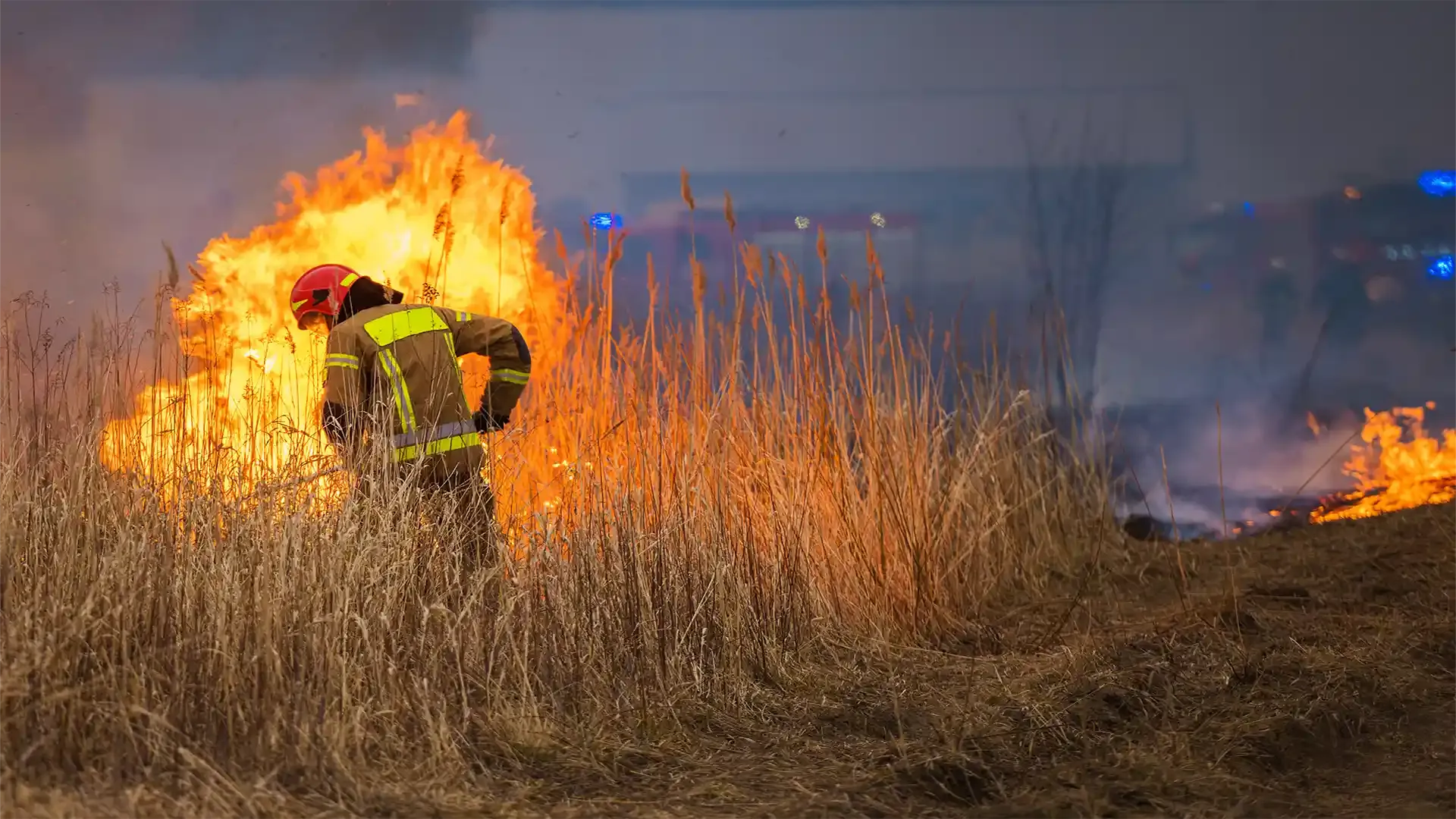
Electrical Fires, Power-Line Safety, and Post-Fire Accountability
The 2018 Woolsey Fire, one of California’s most technically significant electrical fires, ignited when a loose guy wire on Southern California Edison’s Big Rock 16 kV circuit contacted an energized jumper, energizing nearby communication lines and ejecting heated material that ignited vegetation at two sites near the Santa Susana Field Laboratory. The CPUC’s Safety & Enforcement Division (SED) identified 26 violations of General Order 95 for clearance, maintenance, and vegetation management deficiencies. The blaze burned 96,949 acres, destroyed 1,643 structures, and caused three deaths. The California Department of Justice confirmed SCE equipment as the ignition source but filed no charges, while the Department of Toxic Substances Control (DTSC) found no radiological or chemical releases at the site.
Subsequent regulatory proceedings focused on financial accountability. Southern California Edison filed Application A.24-10-002 with the California Public Utilities Commission (CPUC) in 2024 to recover about $5.4 billion in wildfire claim payments and $84 million in restoration costs. Edison International’s Form 8-K, filed September 19, 2025, disclosed a proposed Woolsey Settlement Agreement, subject to CPUC approval, under which SCE would recover roughly 35 percent (about $2.0 billion) of approximately $5.6 billion in verified 2017–2018 wildfire and mudslide losses (primarily tied to the Woolsey Fire), along with $71 million of $84 million in restoration costs, financed through securitized bonds or, if necessary, long-term debt over five years. By this point, all criminal and CPUC enforcement matters had concluded; only final CPUC approval of the cost-recovery settlement remained pending, marking the administrative close of a largely resolved case that redefined accountability for electrical-fire prevention and cost recovery in California.
Woolsey Fire Chronology of Events and Technical Findings: Electrical Fires Cause, Expert Analysis, and Final Resolution
November 8, 2018 – Electrical Contact Ignites Twin Fire Origins Near SSFL
A loose guy wire on Southern California Edison’s Big Rock 16 kV circuit contacted an energized jumper, causing electrical contact that energized communication lines and produced heated material which ignited vegetation at two sites. A second ignition occurred when energized communication lines made contact, propelling flames through the Santa Susana Field Laboratory. Electrical engineering experts from the CPUC’s Safety & Enforcement Division later analyzed the electrical fault mechanics and conductor contacts, informing the Commission’s compliance findings and enforcement rulings, and documenting 26 violations of General Order 95 for design, maintenance, and vegetation management.
November 21, 2018 – Containment and Extent of Damage
Authorities declared the fire 100% contained after burning 96,949 acres, destroying 1,643 structures, and causing three fatalities. More than 295,000 residents were evacuated from Ventura and Los Angeles Counties. SED’s electrical engineers confirmed that energized hardware and vegetation contact exemplified known ignition pathways in electrical fires, demonstrating how line faults can trigger large-scale wildfires.
December 18, 2018 – Interim Environmental Findings: No Detected Contamination
DTSC issued an interim report concluding that field and laboratory analyses of air, ash, and soil revealed no release of hazardous or radiological contaminants from the Santa Susana Field Laboratory. Neutral environmental experts from DOE, EPA, and LA County DPH participated in the investigation, providing radiation and chemical sampling that verified the site remained stable after the fire.
December 2020 – DTSC Final Report Confirms Safe Conditions
DTSC’s final summary reaffirmed that no contamination escaped SSFL, despite 80 percent of the facility’s area being burned. The agency’s multi-disciplinary expert team, including radiological and toxicology experts, corroborated earlier results using expanded datasets and post-fire modeling. Their analysis established that elevated stormwater readings stemmed from ash and vegetation loss, not industrial waste releases.
August 13, 2021 – DOJ Confirms Utility-Caused Ignition and Closes Inquiry
The California Department of Justice confirmed that SCE’s electrical and communication equipment caused the Woolsey Fire and formally closed its inquiry after determining no further legal action was warranted. The agency relied on electrical-system experts and fire-cause analysts who examined circuit design, ignition modeling, and video evidence to validate CPUC findings. Their technical evaluation reinforced the conclusion that a guy-wire contact with an energized conductor triggered the blaze.
December 2021 – CPUC Resolution SED-5 and Safety Penalties
The California Public Utilities Commission adopted Resolution SED-5 (December 20, 2021), an Administrative Consent Order resolving the Woolsey Fire and other 2017–2018 utility-related fires. The order required Southern California Edison shareholders to pay $110 million in penalties, invest $65 million in safety-improvement projects, and accept permanent cost disallowances, including about $250 million for the Woolsey Fire and $125 million for other fires that cannot be recovered from ratepayers.
These actions, based on the CPUC Safety & Enforcement Division’s finding of 26 General Order 95 violations, concluded the state’s enforcement phase of Woolsey Fire accountability.
October 8, 2024 – SCE Files for Cost Recovery
SCE filed Application A.24-10-002 with the CPUC seeking recovery of approximately $5.4 billion in third-party claim settlements and $84 million in system restoration costs. In SCE’s application, as described by the CPUC Public Advocates Office, 656 lawsuits comprising 9,574 plaintiffs had been initiated. SCE reported that as of August 31, 2024, it had resolved third-party claims representing about 92 percent of its estimated liabilities, with remaining claims including those by the California Office of Emergency Services (Cal OES), a cross-claim from the Mountains Recreation and Conservation Authority (MRCA), and individual plaintiffs from roughly 235 households.
November 12, 2024 – Public Advocates Office Challenges Recovery Request
The CPUC’s Public Advocates Office filed a protest, arguing that costs tied to equipment failures identified by expert investigators should not be charged to customers. The filing opened formal discovery and hearings on prudence and cost allocation.
September 19, 2025 – Settlement Agreement Filed; CPUC Approval Sought
Edison International’s Form 8-K (September 19, 2025) announced a proposed Woolsey Settlement Agreement, subject to CPUC approval, under which Southern California Edison would recover 35% (approximately $2.0 billion) of about $5.6 billion in verified 2017–2018 wildfire and mudslide losses, primarily tied to the Woolsey Fire, plus about $71 million of $84 million in restoration costs. The agreement would allow SCE to seek securitized bond financing, and if securitization is denied, to recover the authorized amount over five years using long-term debt.
With all criminal and CPUC enforcement matters concluded, only final CPUC approval of the proposed recovery plan remained pending, marking the last administrative step in resolving the Woolsey Fire’s regulatory proceedings.
Expert Contributions: Electrical, Fire, and Environmental Analysis
-
Electrical Engineering Government Investigators and Technical Expert Witnesses (Neutral Experts)
- Electrical engineering experts from the CPUC’s Safety & Enforcement Division conducted detailed analyses of Southern California Edison’s infrastructure, identifying how a loose guy wire contacting an energized 16 kV jumper caused electrical contact that energized communication lines and produced heated material which ignited vegetation at two sites.
- Their findings documented 26 violations of General Order 95 related to line clearance, guying, and maintenance standards. Their technical analysis formed the foundation of the official cause determination and subsequent enforcement rulings.
-
Fire-Cause and Origin Government Investigators and Technical Expert Witnesses (Neutral Experts)
- Fire-cause investigators from CAL FIRE and Ventura County reconstructed ignition points known as “Site 1” and “Site 2,” verifying that energized communications hardware and vegetation contact produced dual ignition sites. Their analytical findings aligned with CPUC and DOJ conclusions that the Woolsey Fire originated from SCE electrical and communications equipment.
-
Environmental and Radiological Government Investigators and Technical Expert Witnesses (Neutral Experts)
- Environmental and radiological experts from DTSC, DOE, EPA, and the Los Angeles County Department of Public Health participated in post-fire sampling and air-quality assessments at the Santa Susana Field Laboratory. Their testing confirmed no release of hazardous or radiological contaminants, based on multi-agency laboratory results. These neutral government experts, acting in an independent regulatory capacity, provided assurance regarding environmental safety and contamination control.
-
Electrical Fires Expert Witness
- Electrical fires expert witnesses are often retained in utility-related fire cases to interpret system-fault behavior, arc-flash ignition, and equipment compliance under safety codes. Such experts typically analyze conductor contact, insulation failure, and heat transfer patterns, providing insight consistent with the CPUC’s arc-flash findings. Their discipline is central to understanding ignition mechanisms in electrical fire litigation.
-
Safety Compliance Expert Witness
- Safety compliance expert witnesses are commonly engaged to assess whether utilities and contractors adhere to applicable electrical safety codes, maintenance protocols, and operational standards such as General Order 95. In regulatory investigations like the Woolsey Fire, their evaluations typically inform findings on compliance, corrective measures, and accountability frameworks.
Legal Insights and Strategic Takeaways from the Woolsey Fire: Electrical Safety, Liability, and Regulatory Insights
-
Early Technical Causation Analysis Strengthens Liability Defense
The Woolsey Fire demonstrated the importance of securing qualified electrical engineering experts immediately after a utility-related fire. Their early identification of a guy wire contacting an energized conductor allowed regulators to establish causation with precision. Attorneys handling electrical fire litigation benefit from early system analysis.
-
Regulatory Compliance Findings Can Define Settlement Exposure
The CPUC’s citation of 26 General Order 95 violations established a framework for liability and cost disallowance. Counsel representing utilities should treat compliance audits as central evidence in electrical fire cases, since adherence or failure to adhere to safety standards directly influences settlement outcomes.
-
Environmental Testing Can Narrow Damages and Liability Scope
Environmental expert analyses confirmed no chemical or radiological releases, limiting secondary claims and reducing liability exposure. Independent contamination assessments can clarify the scope of electrical fire damages and separate primary ignition causes from environmental allegations.
-
Settlement Structuring Under Regulatory Oversight Requires Early Strategy
SCE’s proposed settlement which, if approved by the CPUC, would allow recovery of about 35% (approximately $2.0 billion) of roughly $5.6 billion in verified 2017–2018 wildfire and mudslide losses, primarily tied to the Woolsey Fire, underscores how financial recovery in utility-related wildfire cases depends on regulatory negotiation. Attorneys should design parallel administrative and settlement strategies early to balance ratepayer protection, shareholder obligations, and regulatory oversight in electrical-fire recovery proceedings.
-
Electrical Fire Evidence Demands Interdisciplinary Coordination
Legal teams must integrate fire-origin analysis, electrical forensics, and vegetation management records to establish or defend liability. The Woolsey Fire illustrates how arc-flash ignition and conductor contact evidence determine both factual and regulatory outcomes.
Conclusion
The Woolsey Fire remains a landmark case in California wildfire litigation, linking electrical infrastructure, regulatory compliance, and cost recovery. All criminal and CPUC enforcement proceedings had concluded; as of September 19, 2025, only CPUC approval of Southern California Edison’s proposed Woolsey Settlement Agreement remained pending. If approved, the agreement would authorize recovery of about 35% (approximately $2.0 billion) of roughly $5.6 billion in verified 2017–2018 wildfire and mudslide losses, primarily tied to the Woolsey Fire, plus about $71 million of $84 million in restoration costs. This final administrative step illustrated how regulatory remedies can substitute for courtroom verdicts in electrical-fire accountability.
The case also deepened understanding of electrical-fire mechanics, showing how conductor contact and vegetation intrusion can escalate into catastrophic wildfires. For attorneys, it reinforces the value of early expert engagement, compliance audits, and environmental testing in wildfire litigation.